Brothers' Tower
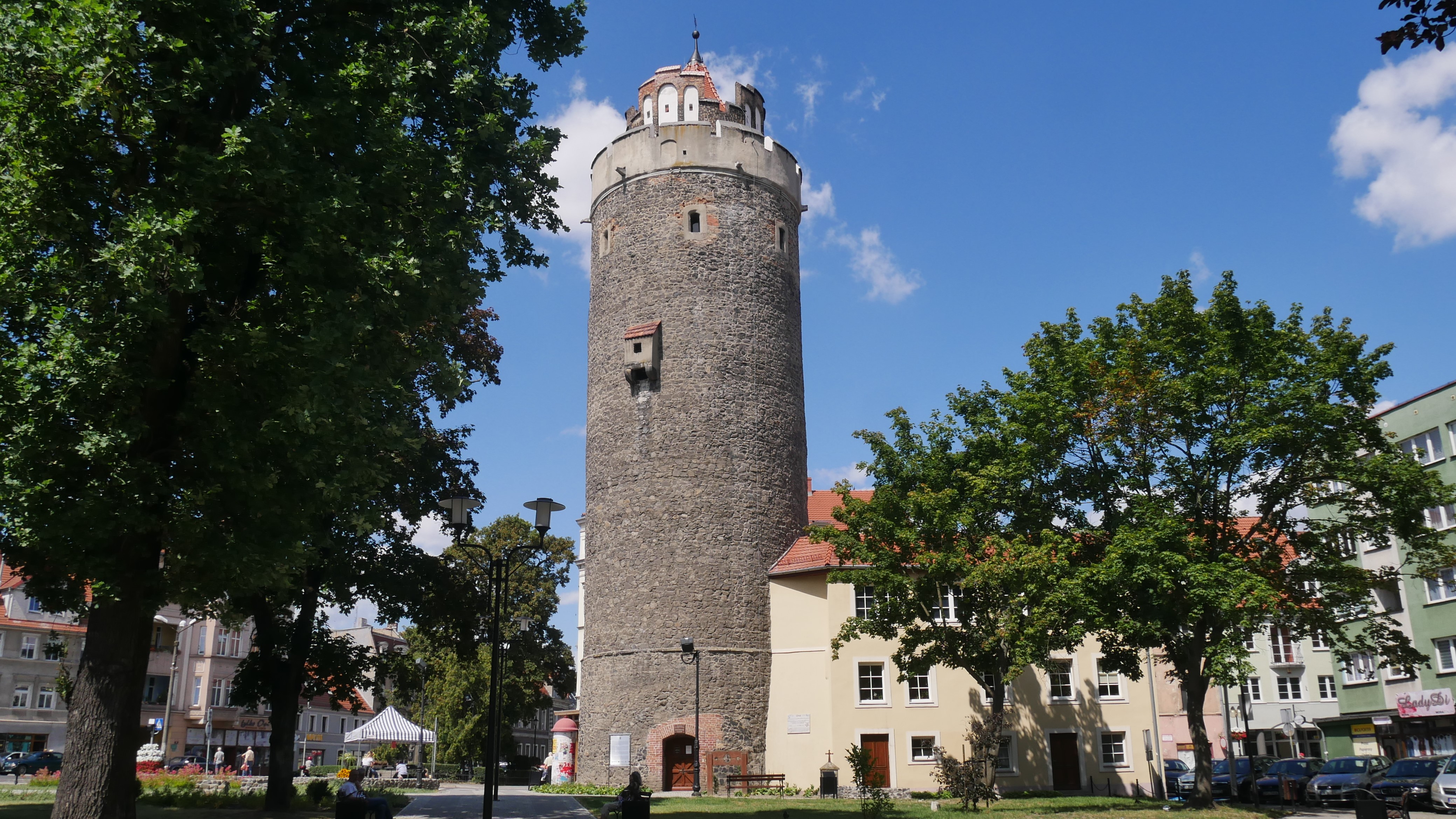
You are standing in the Independence Park, built on the site of moats that once surrounded the city walls and were buried later on. In front of you, there stands a medieval Bracka Tower - one of the most interesting buildings in Lubań. Inside of it, you can feel the atmosphere of past centuries, see the exhibition "Minerals of the Western Sudety Mountains", and climb to the top of the tower to admire the very summit of Lubań's volcano - Kamienna Góra and the panorama stretching from Upper Lusatia to the Izery Mountains.
Built in 1318, The Monks' Tower strengthened the possibility to defend both the city’s main gate and the Franciscan monastery, which is placed tight in its immediate vicinity. The tower owes its name to the Franciscan monks.
The tower is made of basalt and was built on a circular plan. It is 45 metres tall its 3-metre-thick walls all the way up to the 5th floor are astonishing.
Originally, the entrance to the tower was on the city side at the level of the second floor. Even higher up, there was a clerestory bay, which is still visible even today. All the ceilings, except for the top one, were wooden. The towers are surmounted by two porches with a pointed roof.
Interestingly, in spite of some tragic events concerning Lubań throughout the years such as wars, epidemics and fires, the tower has survived up to this day and was conquered only once over the years. During the second Hussite invasion in the 1530s, the only point of resistance in the town was the Bracka Tower, where a group of desperate residents led by Bernard of Uchtritz took refuge. The Hussites used a trick to drive out the defenders. They dug an underpass under the tower, filled it with flammable materials and set it on fire. The tower acted as a chimney and filled with choking smoke. Seeing no chance of survival, the residents of Lubań surrendered. Years later, during the Thirty Years' War - in 1639 and 1641 - the Swedes tried unsuccessfully to demolish the tower.
Now look to your left and you will see a salmon-coloured corner building - this is the seat of the Lubań Town Hall. Built in the second half of the 19th century, it was originally converted into a town hotel. Just behind the building, there is the Wawel Cinema. In the city park you can visit a unique museum dedicated to the Battle of Luban in 1945. – which is nothing else than an air-raid shelter with an exhibition of artefacts from the Second World War.
Luban is not only a place of historical buildings but there are also about 50 monuments of nature in Lubań. One of them is the Turkish hazel tree which you will find in the Independence Park.
On the right, in the building next to the Brothers' Tower, is the Tourist Information Office, where you can get maps, tourist leaflets and souvenirs.
 Explore


