Holy Trinity Church
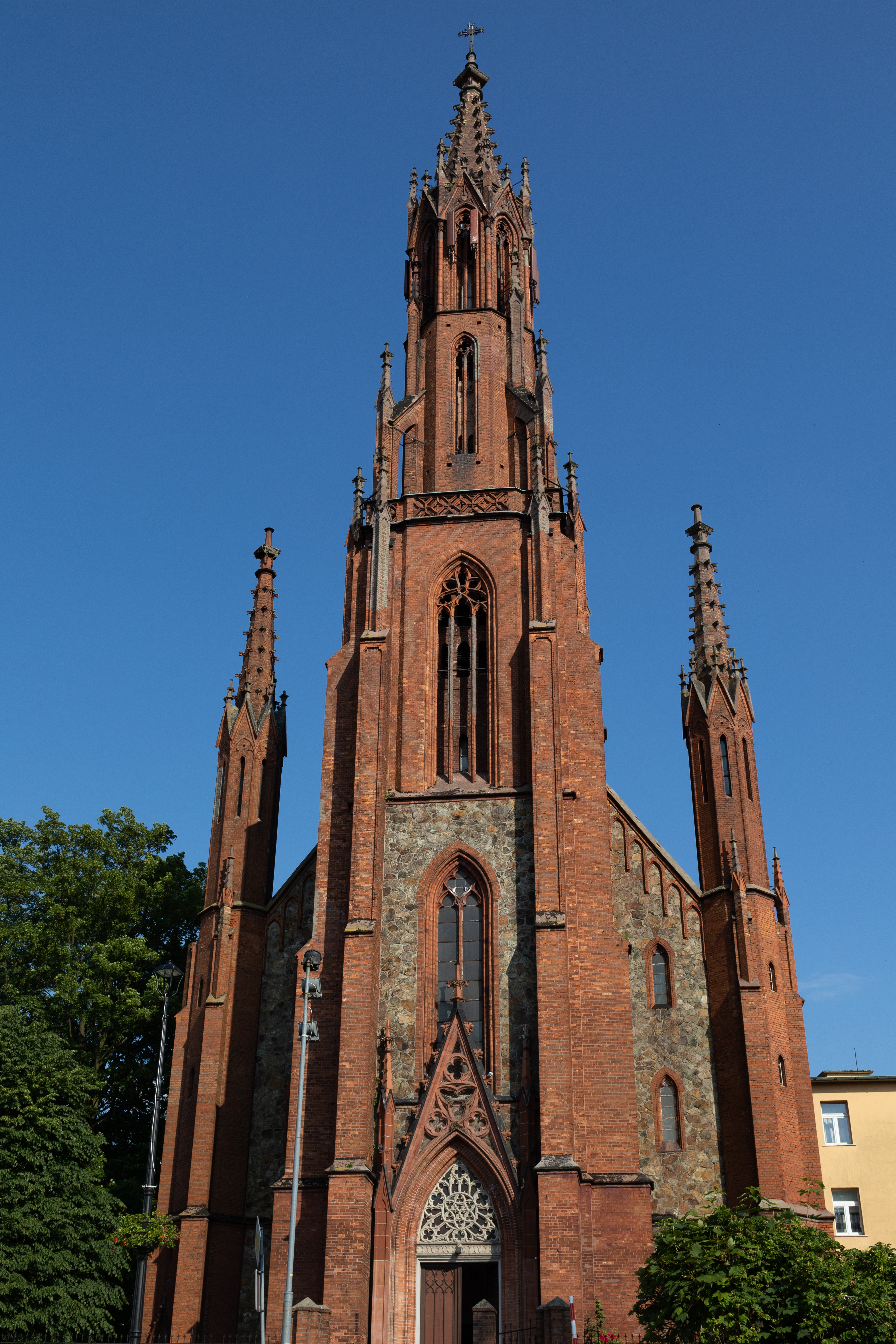
The neo-Gothic Church of the Holy Trinity, built between 1857 and 1861 on the initiative of the Monastery of St Mary Magdalene, is a towering red edifice over Lubań. It was designed by the eminent Silesian architect Alexis Langer, but the Lubań master bricklayer Albert Augustin, who supervised the construction, incorporated a number of his own solutions into his design. A prominent clergyman, Father Adalbert Anter, chaplain of the monastery and pastor of the Catholic parish in Lubań, played an important role in the preparation and execution of the investment.
Upon entering the church, one's attention is drawn to the monumental painting of the Holy Trinity on the high altar by Eduard von Engerth, the director of the Prague School of Fine Arts. The altar in the left nave, the pulpit and the Way of the Cross complete and complement the chapel.
During the Battle of Lubań in 1945, the church came under fire and was badly damaged and it was decided to rebuild the church in August 1957. It was prelate Jan Winiarski who undertook the difficult and costly task. Interestingly, the reconstruction of the church took place between 1957 and 1961, while the original church was built between 1857 and 1861 which means that yet again history came a full circle.
Next to the entrance, on the right, there is a burial mound erected in memory of Józef Piłsudski and Aleksandra Piłsudska, née Szczerbińska, who were interned in Lubań in 1915-1916. Nearby, there is a statue of St Catherine, brought from the site of the railway repair works which was closed down in Lublin.
Interesting fact:
Albert Augustin, a master bricklayer, city councilor and director of the Bricklayer's School, worked in the Lubań Ceramics Factory, where he produced exceptionally beautiful red bricks that won hearts all over Europe and were even later found in South America. Berlin's magnificent town hall - the Rotes Rathaus - was also built from the bricks from Lubań.
Have you ever wondered about the white statue that stands on a hill near the starting point of the city wall? It is the statue of St Mary Magdalene, the patron saint of Lubań since 2017. The patronage of St Mary Magdalene has a deep connection with the history of our town. For almost 700 years, Luban has been home to the Congregation of the Sisters of St Mary Magdalene of Penance, which now has the status of the General House of the Congregation. You will see the convent on the right, past the crossroads, with the entrance to the church behind you.
 Explore


